
Endeavor Meaning: Definition, Examples & Usage
Endeavor meaning refers to a serious effort or determined attempt to accomplish something. It can describe a goal, project, task, or other activity that requires time and commitment.
In American English, endeavor works as both a noun and a verb. As a noun, it means an effort or undertaking. As a verb, it means to make a serious effort to achieve a result. For example, “She began a new business endeavor” describes an undertaking, while “We will endeavor to help” means “We will make every effort to help.”
The word sounds more formal than everyday words such as try, effort, or attempt. You may see it in professional writing, academic writing, business communication, formal conversation, and polished statements. It is a standard English word, not texting slang or internet slang.
What Does Endeavor Mean?
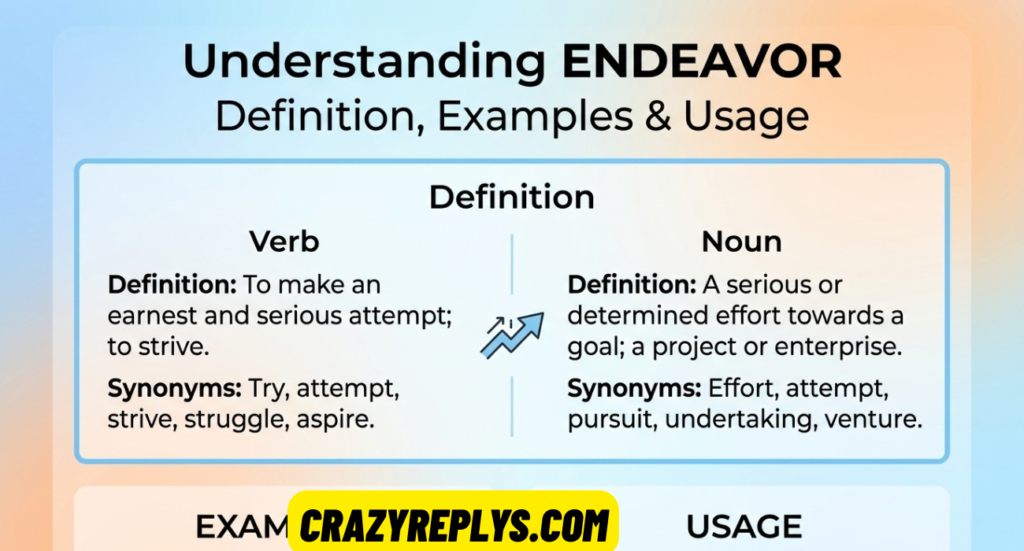
Endeavor means a serious effort or attempt to achieve a particular goal. It suggests that someone is putting time, energy, commitment, or persistence into something.
As a noun, endeavor refers to an effort, undertaking, or pursuit:
“Starting the company was a challenging endeavor.”
Here, endeavor means a difficult undertaking that required meaningful effort.
As a verb, endeavor means to try hard or make a determined effort:
“We will endeavor to complete the project on time.”
In this sentence, the speaker means that the team will make a serious effort to finish the project.
The word can describe both successful and unsuccessful efforts. An endeavor does not guarantee a positive result. It focuses more on the intention and effort involved.
Read Also : Professional Thank You Messages for Appreciation: 140+ Heartfelt
Endeavor Meaning in Detail
The word endeavor has two closely related grammatical uses. Understanding them makes the term much easier to use correctly.
Endeavor as a noun: It means a serious effort, undertaking, or pursuit.
“Learning a new language can be a rewarding endeavor.”
Endeavor as a verb: It means to try or make a serious effort.
“The team will endeavor to solve the problem.”
In both cases, the word carries a sense of purpose and commitment. It often sounds more deliberate than simply saying “try.”
For example, “I’ll try to finish it” sounds natural in casual conversation. “I’ll endeavor to finish it” sounds more formal and intentional.
Is Endeavor a Formal Word?
Yes. Endeavor is a formal word, although it is still part of standard everyday English. People commonly use it in professional writing, academic writing, business communication, official statements, and other situations where a polished tone fits.
In casual conversation, try or make an effort usually sounds more natural:
Casual: “I’ll try to finish it tonight.”
Formal: “I’ll endeavor to complete it tonight.”
That difference does not mean endeavor is too formal to use outside work. You can use it in ordinary speech, but it may sound more serious or polished than the simpler alternatives.
In American English, endeavor is the usual spelling. Endeavour is the common British English spelling.
Is Endeavor Slang?
No. Endeavor is not slang. It is a standard English word with established meanings as both a noun and a verb.
It is also not a special texting abbreviation. If someone writes “This is my biggest endeavor,” they are using the normal dictionary sense of the word.
The confusion may come from seeing the word on social media, in messages, or in online conversations. A word does not become slang simply because people use it on a social platform.
For example:
“My new business is a huge endeavor.”
This sentence uses endeavor normally. It means the business is a major undertaking that requires substantial effort.
How Context Changes the Meaning
The basic idea stays the same, but the specific meaning of endeavor depends on what someone is trying to accomplish. The surrounding words can show whether the speaker means a personal goal, work task, difficult project, or something more playful.
1. A personal goal
An endeavor can describe something you personally want to achieve.
“Training for my first marathon has become a meaningful endeavor.”
Here, endeavor refers to the person’s determined effort toward a personal goal.
It can also describe education, fitness, learning a skill, writing a book, or building a new habit.
2. A professional task
At work, endeavor often describes a serious professional effort or undertaking.
“The company’s latest endeavor focuses on improving customer service.”
The word gives the task a professional and purposeful tone. It can work well when describing a new initiative, business project, or long-term objective.
3. A difficult project
People often use endeavor for something that requires considerable time or persistence.
“Restoring the old building was a demanding endeavor.”
The sentence suggests more than a simple task. The restoration required planning, work, and determination.
4. A playful conversation
Although endeavor usually has a serious or formal tone, friends can use it humorously.
Friend A: “I’m attempting to bake bread for the first time.”
Friend B: “Good luck with this ambitious endeavor!”
The second speaker may be joking because baking bread is not necessarily a major undertaking. The formal word creates a playful contrast with the ordinary situation.
Endeavor in Text and Chat
The endeavor meaning in text remains the same as it does in standard English. It usually means an effort, attempt, undertaking, or serious try.
For example:
“I hope your new endeavor goes well.”
The sender is wishing the other person success with a new project, goal, or undertaking.
Because endeavor sounds more formal than try, it can feel slightly polished in a text message. That does not make it slang.
Consider this exchange:
Person A: “I’m opening my own online store.”
Person B: “That’s an exciting endeavor. Best of luck!”
The word fits because starting a business requires effort and commitment.
If someone asks “What does endeavor mean in text?”, the simplest answer is: it means a serious effort, attempt, or undertaking. The meaning does not change just because the conversation happens through a phone.
Endeavor on Social Media
The endeavor meaning on social media is generally the same as in standard American English. Posts on TikTok, Snapchat, Instagram, and other platforms may use the word to describe a goal, project, challenge, or major personal effort.
For example:
“Starting my fitness journey is my latest endeavor.”
Here, endeavor means a personal undertaking.
A social-media creator might also write:
“Wish me luck on my latest creative endeavor!”
That could refer to a video project, art project, business idea, or another creative pursuit.
There is no special endeavor slang meaning associated with TikTok or other social platforms. Context still matters, especially when someone uses the word humorously or dramatically.
Real Conversation Examples
The following examples show how endeavor can sound different depending on the situation.
1: Workplace
Manager: “How is the new customer-support project going?”
Employee: “It has been challenging, but we’re making steady progress.”
Manager: “Good. I appreciate everyone’s effort in this endeavor.”
Here, endeavor refers to the shared professional undertaking. The tone is formal and appropriate for a workplace discussion.
2: Friends
Alex: “I’m going to learn how to play guitar this year.”
Sam: “That’s quite an endeavor. I hope you stick with it!”
Between friends, the word can sound slightly formal. Depending on the situation, that contrast can make the sentence playful without changing the actual meaning.
3: Academic conversation
Student: “Researching this topic took several months.”
Professor: “A project of that scope is certainly a worthwhile endeavor.”
In academic conversation, endeavor can describe serious research, study, or another demanding intellectual undertaking.
What Tone Does Endeavor Have?
Endeavor usually has a formal, serious, neutral, or professional tone. It can suggest commitment and purpose.
The tone depends partly on how you use it. In a business report, “a major strategic endeavor” sounds professional. In a message to a friend, “Good luck with your latest endeavor!” may sound formal or deliberately humorous.
The word does not automatically express success. Someone can describe a failed project as an endeavor because the term focuses on the effort or undertaking.
Compare these words:
- Try: simple and conversational
- Effort: neutral and common
- Attempt: neutral, with emphasis on trying to do something
- Endeavor: more formal and often suggests sustained effort
- Undertaking: formal and often refers to a substantial task or project
Is Endeavor Rude?
No. Endeavor is not inherently rude. It is a standard word that usually communicates seriousness, effort, or purpose.
However, context can change how any word feels. If someone uses an unusually formal expression during a casual conversation, it might sound stiff or humorous. That does not make the word offensive.
For example:
“Good luck with your endeavor.”
This can sound sincere and supportive.
But if a friend says it jokingly after you announce that you are trying to assemble a small piece of furniture, the formal wording may create humor.
The relationship between the speakers, sentence wording, punctuation, and overall context can affect the tone.
How to Reply to Endeavor
Your reply depends on what the person means by endeavor. If they are discussing a project, you can respond with encouragement. If they use the word jokingly, a playful answer may fit better.
Friendly Replies
For a friend, natural responses include:
“Thanks! I’m excited to see how it goes.”
“I appreciate that. I’m giving it my best.”
“Thanks! Hopefully, all the hard work pays off.”
These replies acknowledge the person’s good wishes without making the conversation overly formal.
Funny Replies
If someone uses endeavor in a playful way, you can match the humor:
“A noble endeavor indeed!”
“Wish me luck on this legendary mission.”
“I accept this mighty endeavor.”
The humor comes from treating an ordinary task as though it were a grand undertaking.
Polite Replies
In a professional or formal setting, you could say:
“Thank you. I appreciate your support.”
“Thank you. I’ll make every effort to complete it successfully.”
“I appreciate that. We’ll do our best to achieve the goal.”
These responses maintain a professional tone without sounding unnatural.
When to Use the Word Endeavor

Use endeavor when you want to describe a meaningful effort, serious attempt, or substantial undertaking.
It works particularly well in:
- Professional writing
- Academic writing
- Business communication
- Formal conversation
- Reports and presentations
- Descriptions of challenging projects
- Discussions about personal goals
- Polished statements about future efforts
For example:
“The team’s latest endeavor required careful planning.”
“She views education as a lifelong endeavor.”
“We will endeavor to provide a timely response.”
Use it when the situation genuinely involves effort or purpose. In very casual conversations, a simpler word may sound more natural.
Read Also : Romantic Happy New Month Messages to My Love
When to Avoid Endeavor
You do not need endeavor every time you mean “try.” In a quick text or everyday conversation, it can sound more formal than necessary.
For example:
“I’ll try to call you later.”
This sounds natural between friends.
“I’ll endeavor to call you later.”
This is grammatically correct, but it sounds more formal and deliberate.
Avoid using endeavor when a simpler word communicates your meaning more clearly. Good writing does not depend on choosing the most sophisticated word. It depends on choosing the word that fits the situation.
Common Mistakes With Endeavor
One common mistake is treating endeavor as slang. It is not slang. It is a standard English word.
Another mistake involves using it when there is no real sense of effort or undertaking. Endeavor normally refers to an attempt, effort, pursuit, or project.
People also sometimes confuse its noun and verb forms:
Noun: “The project was a major endeavor.”
Verb: “We will endeavor to finish the project.”
Another point to remember is spelling. Endeavor is standard American English, while endeavour is commonly used in British English.
Finally, do not assume that endeavor means success. An endeavor can succeed or fail. The word describes the effort or undertaking, not necessarily its final result.
Similar Words to Endeavor
Several words have meanings similar to endeavor, but they are not always interchangeable.
| Word | Meaning | Typical tone |
|---|---|---|
| Try | Make an effort to do something | Casual |
| Effort | Energy used to achieve something | Neutral |
| Attempt | An effort to accomplish something | Neutral |
| Pursuit | Continued effort toward a goal | Neutral/Formal |
| Undertaking | A task or project that requires effort | Formal |
| Endeavor | A serious effort or undertaking | Formal |
Try is usually the easiest choice in casual conversation. Attempt often focuses on the act of trying. Pursuit emphasizes working toward a goal. Undertaking often suggests a substantial task or project.
For polished professional communication, endeavor can work well when the context involves meaningful effort.
Origin and Usage
Endeavor is an established English word used to describe effort, attempts, and undertakings. In modern American English, it functions as both a noun and a verb.
American English generally uses the spelling endeavor, while British English commonly uses endeavour. The two spellings refer to the same word and meaning.
Modern usage ranges from business and academic writing to ordinary conversations. The word tends to sound more formal than try, which explains why it appears frequently in professional or polished language.
Its meaning remains connected to effort and purposeful action. Context determines whether that effort refers to a personal goal, workplace task, academic project, or playful situation.
Endeavor Meaning in American English
In American English, endeavor means a serious effort, attempt, or undertaking. It can describe a personal goal, business project, academic task, or challenging activity. The word works as both a noun and a verb. For example, “This is a worthwhile endeavor” describes an effort, while “We will endeavor to help” means we will make a serious effort.
The spelling endeavor is standard in American English. British English commonly uses endeavour instead. Both forms have the same basic meaning. In everyday American conversation, people often choose simpler words such as “try,” “effort,” or “attempt.” However, endeavor fits naturally when you want a more polished or professional tone.
Endeavor vs. Effort: What Is the Difference?
Endeavor and effort have similar meanings, but they can create different impressions. Effort is a broad, neutral word for energy used to accomplish something. Endeavor often suggests a serious undertaking or determined pursuit. For example, “She made an effort” is simple and common, while “Her research was a significant endeavor” sounds more formal and substantial.
The choice depends on context and tone. Use effort in casual conversation when you want simple wording. Choose endeavor when describing a meaningful project, professional task, academic pursuit, or challenging goal. Neither word guarantees success. Both can describe work that eventually succeeds or fails.
Endeavor Meaning in Professional Communication
In professional communication, endeavor can describe a serious project, organized effort, or business undertaking. It often appears in polished workplace language because it gives a task a purposeful and formal tone. For example, “The team’s latest endeavor focuses on improving customer service” presents the project as a meaningful organizational effort.
You can also use endeavor as a verb in professional writing. “We will endeavor to respond within two business days” means the organization will make a serious effort to respond within that period. This wording sounds formal and courteous. In casual workplace chats, however, “We’ll try to respond soon” may feel more natural.
Endeavor Meaning in Academic Writing
Endeavor can describe research, study, learning, or another demanding academic pursuit. It works especially well when a project requires sustained effort and commitment. For example, “Writing a thesis is a challenging academic endeavor” describes the thesis as a substantial undertaking rather than a simple assignment.
The word can also appear when discussing long-term educational goals. A student might describe learning another language as a worthwhile endeavor because the process requires persistence and practice. Although the word suits academic writing, it should not replace simpler terms automatically. Clear writing matters more than choosing a formal word when “effort” or “project” communicates the idea better.
Quick Recap
Endeavor meaning is simple: it refers to a serious effort, attempt, undertaking, or pursuit. As a noun, it describes something that requires effort. As a verb, it means to make a determined effort to accomplish something.
Endeavor is not slang, and it does not have a special meaning on TikTok, Snapchat, Instagram, or in text messages. It is a standard English word that usually carries a formal or polished tone.
Use endeavor when you want to describe meaningful effort or a substantial undertaking. In casual conversation, words such as try or effort may sound more natural. The best choice depends on your audience, purpose, and context.
FAQs
What Is the Real Meaning of Endeavor?
Endeavor means a serious effort, attempt, or undertaking. It can describe something you work hard to accomplish or an important project you take on.
What Is the Synonym of Endeavour?
Common synonyms for endeavor include effort, attempt, try, pursuit, undertaking, and strive. The best choice depends on the sentence and tone.
What Does Future Endeavors Mean?
“Future endeavors” means the efforts, goals, projects, or activities someone plans to pursue in the future. It often appears in professional good wishes.
How Can I Use Endeavor?
Use endeavor as a noun for an important effort or project, or as a verb meaning “to try.” For example, “She will endeavor to improve her skills.”
Conclusion
Endeavor meaning refers to a serious effort, attempt, or undertaking. As a noun, endeavor describes a meaningful project or pursuit. As a verb, it means to make a determined effort to achieve a goal. The word often sounds more formal than try, effort, or attempt. It fits professional writing, academic work, and situations where a polished tone feels natural.
When you see endeavor in a text, chat, or social media post, use the context to understand its intent. It is a standard English word, not slang, and it has no special meaning on TikTok or other platforms. In casual conversation, simpler words may sound more natural. Understanding the tone helps you choose the right reply and use the word clearly.