WTW Meaning in Text | What Does WTW Mean?
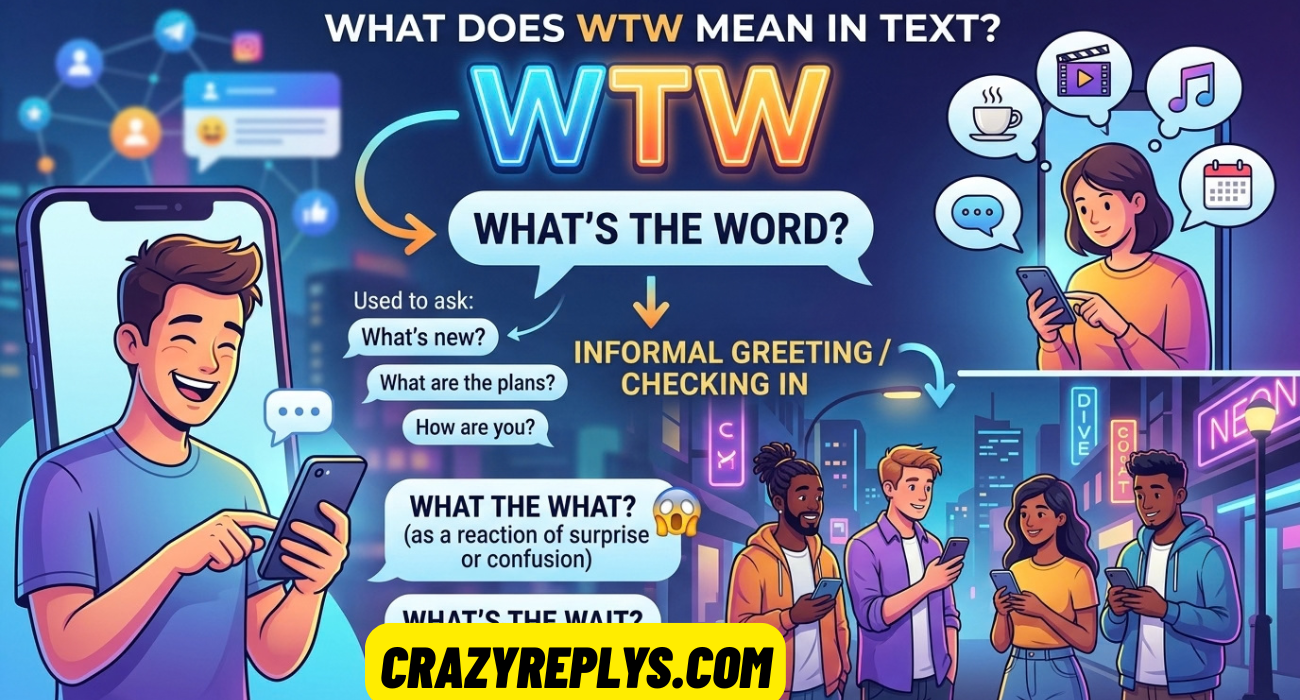
WTW Meaning in Text usually refers to “What’s the word?” in casual messages. People also use WTW to ask what’s going on, what someone is doing, or what the plans are. The exact meaning depends on the conversation and the reason for the message.
You may see WTW in text messages, group chats, Snapchat, Instagram, or other casual conversations. It often has a friendly and relaxed tone rather than a formal one. For example, “WTW tonight?” usually asks about plans for the evening.
This article explains What Does WTW Mean in simple terms and shows how people use the abbreviation. You’ll see real examples, common meanings, tone differences, and ways to reply to WTW. You’ll also learn when this texting slang fits a conversation and when clearer wording works better.
What Does WTW Mean in Text?
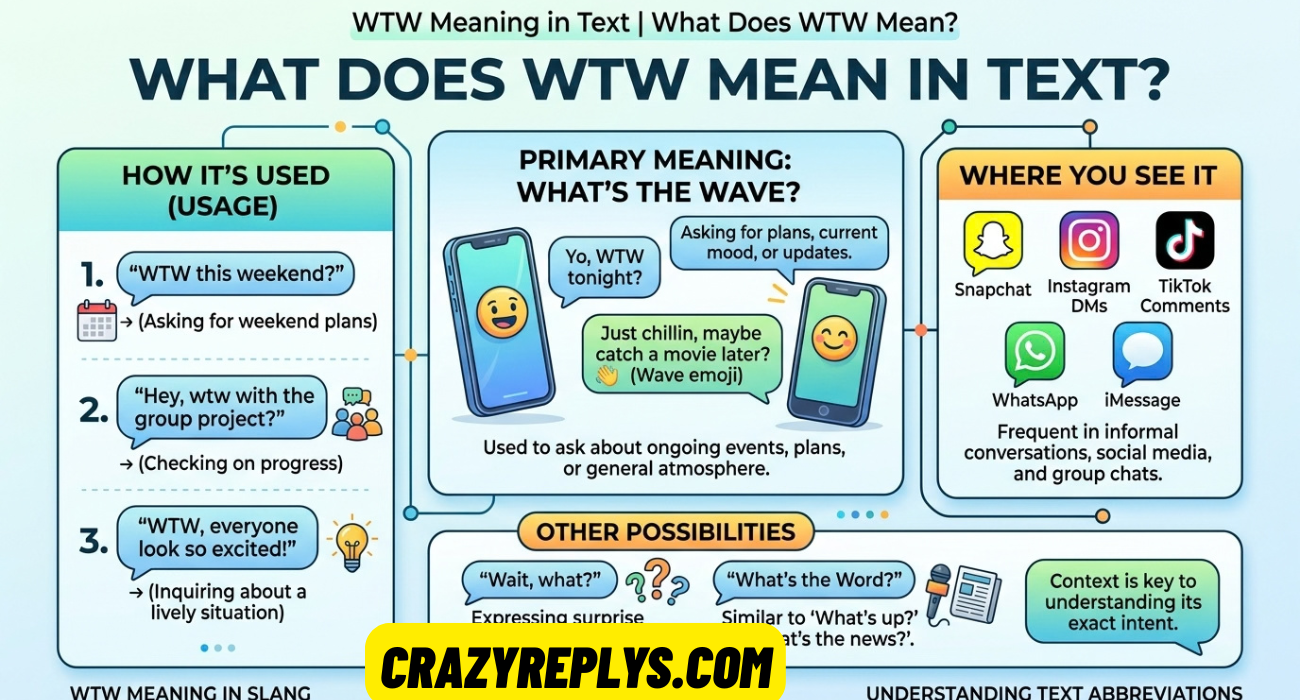
WTW usually means “What’s the word?” In casual texting, “What’s the word?” doesn’t usually refer to a specific word. Instead, it can mean something like “What’s going on?” “What are you up to?” “What are the plans?” or simply “What’s new?”
For example, a friend might text, “WTW tonight?” They’re probably asking what the plans are for the evening. Another person might send only “WTW?” as a broad way to check in and see what’s happening.
The meaning can shift slightly depending on the situation. If someone sends “WTW bro,” they may simply be checking in. If someone sends “WTW Friday?” they’re more likely asking about Friday plans.
Because WTW is a casual abbreviation, it works best between friends, classmates, relatives, gaming communities, and other people who regularly use informal messaging.
Read Also : Endeavor Meaning: Definition, Examples & Usage
WTW Full Form and Slang Meaning
The most common WTW full form in texting is “What’s the word?” It functions as casual slang rather than formal English.
“What’s the word?” is a conversational expression that can invite news, plans, or information. When shortened to WTW, it becomes faster to type and fits naturally into text messages, social media DMs, and group chats.
Depending on context, WTW can communicate several closely related ideas:
- What’s the word?
- What’s going on?
- What are you up to?
- What are the plans?
- What’s new?
- What’s happening?
For example:
Person A: “WTW after work?”
Person B: “Nothing planned yet. You?”
Here, WTW means something close to “What are the plans after work?”
The abbreviation doesn’t have one meaning that fits every conversation. Context provides the missing information.
How Context Changes the WTW Meaning
The WTW meaning can change based on what comes before or after it. A short message such as “WTW?” is broad, while “WTW tonight?” clearly points toward plans for the evening.
Consider these examples:
“WTW?”
This may mean “What’s going on?” or “What’s new?”
“WTW tonight?”
This usually asks about evening plans.
“WTW this weekend?”
This likely asks what someone has planned for the weekend.
“WTW rn?”
Here, “rn” means “right now,” so the sender is asking what’s happening at the moment.
“WTW later?”
This can ask whether someone has plans later or what they might be doing.
The relationship between the people also matters. A close friend may use WTW as a simple check-in. Someone interested in making plans may use it to start a conversation about availability.
Punctuation can also affect the tone. “WTW?” can sound direct but normal in casual texting. “WTW 😂” may feel more playful, while “WTW tonight?” gives the message a clearer purpose.
What Does WTW Mean on Different Platforms?
WTW can appear across several forms of digital communication. Its basic meaning usually stays similar, but the conversation style can vary from one platform to another.
Text Messages
In text messages, WTW is often used between friends who already understand each other’s communication style. It can start a conversation, check what someone is doing, or ask about upcoming plans.
For example:
“WTW after work?”
This probably means, “What are the plans after work?”
Because texting is informal, abbreviations such as WTW can make messages shorter and more conversational.
Snapchat
On Snapchat, WTW may appear in direct messages or casual chats. Someone might send “WTW?” after viewing a friend’s Snap as a way to start talking.
For example:
“WTW later?”
The sender may be asking what the other person plans to do later.
The Snapchat setting can make the phrase feel especially casual, but the meaning still depends on the conversation.
On Instagram, WTW commonly fits into Instagram DMs between friends, acquaintances, or people who already communicate casually.
Someone might reply to a story with:
“WTW this weekend?”
In this case, the sender is probably asking about weekend plans.
WTW can also serve as a quick conversation starter when someone wants to reconnect without writing a longer message.
Group Chats
In group chats, WTW can refer to plans involving several people.
For example:
Mia: “WTW Friday?”
Jordan: “I’m free after 8.”
Alex: “Same here. We could grab dinner.”
Here, WTW acts as a quick way to ask the group what everyone has planned.
The same abbreviation may also appear in gaming communities when players want to know what everyone is doing next.
WTW Examples in Real Conversations
Seeing WTW in realistic situations makes its meaning easier to understand. The following examples show how the abbreviation can work in different types of casual conversations.
1: Friends Making Plans
A: “WTW tonight?”
B: “I’m free after seven. Want to get something to eat?”
Here, WTW means something close to “What are the plans tonight?” The sender is checking availability and opening the door to making plans.
Another example:
A: “WTW Friday?”
B: “Not sure yet. I’ll let you know.”
The exact wording may be short, but the intended question is clear from the reference to Friday.
2: Casual Check-In
A: “Hey, WTW?”
B: “Not much. Just finished work.”
In this situation, WTW works as a casual check-in. The sender may simply want to know what’s going on or what the other person is doing.
It doesn’t necessarily mean the sender wants to make plans. Sometimes it’s just a friendly way to restart a conversation.
3: Group Chat
A: “WTW this weekend?”
B: “I’m around Saturday.”
C: “Same. Maybe we can meet up.”
Here, WTW asks the group about plans and availability. The surrounding conversation makes the intended meaning clear.
In a busy group chat, the abbreviation can save time and quickly shift attention toward making plans.
Is WTW Rude?
WTW is not inherently rude. It is normally a casual and informal expression.
However, tone depends on the relationship and the situation. A close friend may see “WTW?” as completely normal. In a formal setting, the same message could seem too casual or unclear.
For example, texting a friend:
“WTW bro?”
sounds relaxed and familiar.
Sending “WTW?” to a client or using it in a formal business email would be inappropriate because professional communication usually requires clearer wording.
If someone seems confused or annoyed by WTW, the issue may come from the context rather than the abbreviation itself.
Is WTW Flirty?
WTW is not automatically flirty. Its basic meaning does not indicate romantic interest.
However, someone can use WTW in a flirty or playful conversation. Context matters. The relationship between the people, previous messages, emojis, and the topic can all influence how the message feels.
For example:
“WTW tonight? 👀”
could have a playful or suggestive tone if the conversation already has that style.
On the other hand:
“WTW for the group project?”
is clearly practical and has nothing to do with flirting.
So, the WTW slang meaning stays generally the same, while the tone can change based on the surrounding conversation.
How to Reply to WTW
Your reply should match what the sender appears to mean. If they are asking about plans, tell them your plans. If they are checking in, you can simply say what you’re doing.
Friendly Replies
If a friend sends “WTW?” you can keep your response short and natural:
- “Not much. What about you?”
- “Just chilling. You?”
- “I’m free tonight. What’s up?”
- “Nothing planned yet.”
- “Just got home from work.”
- “I’m around later. What are you thinking?”
These replies work well for casual conversations because they keep the conversation moving without sounding formal.
Funny Replies
If the conversation has a playful tone, you can answer with humor:
- “WTW? Snacks. That’s the plan.”
- “Apparently, I’m doing absolutely nothing 😂”
- “The word is ‘pizza.’”
- “Trying to survive Monday.”
- “Same old chaos. What about you?”
A funny reply works best when you already know the person and understand their sense of humor.
Replies When You Are Confused
Sometimes you may not know what the sender means by WTW. There’s nothing wrong with asking for clarification.
Try:
- “What do you mean by WTW?”
- “Do you mean what’s going on?”
- “Are you asking about tonight?”
- “WTW as in what’s the word?”
- “Not sure what you mean. Can you clarify?”
A clear question prevents you from guessing incorrectly, especially when the message has little surrounding context.
When to Use WTW
WTW works best in casual texting and informal messaging. You can use it when the people involved already understand abbreviations and relaxed communication.
Common situations include:
- Texting friends
- Messaging classmates
- Talking in a group chat
- Casual social media messages
- Snapchat conversations
- Instagram DMs
- Gaming communities
- Making plans
- Checking in with someone
- Asking about current activity
For example, “WTW tonight?” is natural when you want to know whether your friends have plans.
The abbreviation can also work when you want to start a conversation without sending a long message. Its broad meaning gives the other person room to respond with news, plans, or an update.
When to Avoid WTW
Avoid WTW when the situation requires clear, formal, or professional language. The abbreviation can confuse readers who don’t recognize common texting slang.
It usually doesn’t belong in:
- Professional emails
- Academic writing
- Formal announcements
- Client communication
- Job applications
- Business documents
- Official requests
Instead of writing “WTW?” to a client, you could write, “Do you have any updates?” If you’re asking about a meeting, say “What are the plans for the meeting?”
Clear wording matters more than brevity in formal communication.
Common Mistakes About WTW
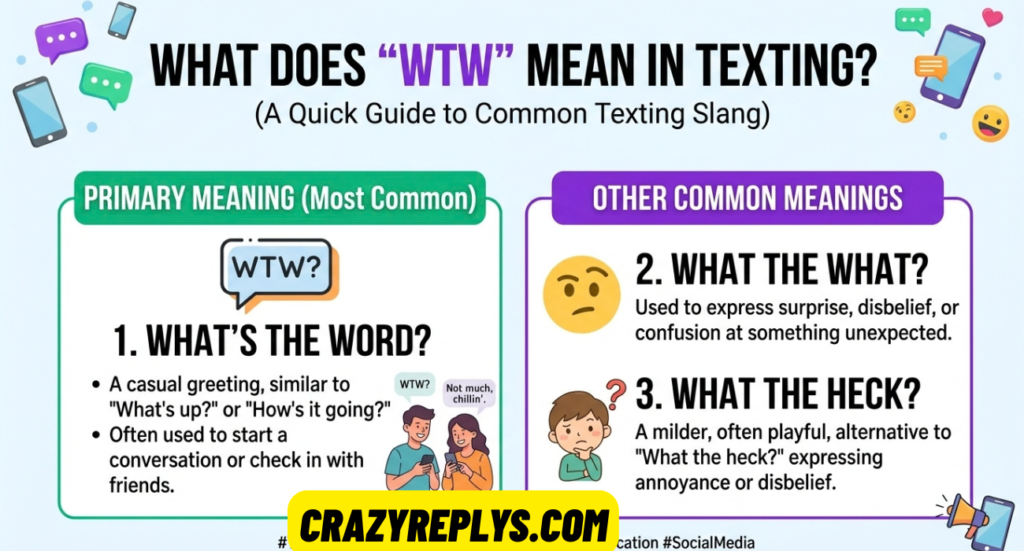
One common mistake is assuming WTW always means exactly the same thing. “What’s the word?” is the most common interpretation in casual texting, but the intended question can range from “What’s going on?” to “What are the plans?”
Another mistake is assuming WTW is automatically flirty. It isn’t. Romantic interest may affect the tone, but the abbreviation itself does not communicate romance.
People also sometimes confuse WTW with similar texting abbreviations such as WSG, WYO, WYD, and WYA. These expressions overlap in casual conversation, but they ask slightly different questions.
Finally, avoid treating WTW as appropriate for every setting. It belongs mainly to informal communication. Professional emails and formal messages usually benefit from direct, complete wording.
Read Also : Deep Love Messages for Her: 260+ Romantic, Emotional & Heartfelt
Similar Slang Terms
Several common texting abbreviations can sound similar to WTW because they help people start conversations or ask what someone is doing.
| Slang | Common meaning | Typical use |
|---|---|---|
| WTW | What’s the word? | Asking what’s happening or what the plans are |
| WSG | What’s good? | Casual greeting or check-in |
| WYO | What you on? | Asking what someone is doing or planning |
| WYD | What you doing? | Asking about current activity |
| WYA | Where you at? | Asking about someone’s location |
| What’s good | How are things? | Casual greeting |
| What you on | What are you doing/planning? | Informal check-in |
These terms can overlap, but they aren’t interchangeable in every situation. WYD focuses more directly on current activity, while WYA usually asks about location. WTW is broader and can ask about plans, activity, news, or what’s happening.
Where Does WTW Come From?
WTW is a shortened form of the conversational expression “What’s the word?” It follows the same general pattern as many texting abbreviations: longer phrases get reduced to a few letters to make informal messaging faster.
The expression “What’s the word?” has a broader conversational sense than simply asking for a word. In casual speech, it can invite someone to share news, plans, or information.
The exact origin of the abbreviation as a texting form is not something that should be treated as a single documented event. It’s safer to understand WTW as part of contemporary informal messaging rather than assign it to one specific person, platform, or date.
Today, WTW appears in text messages, social media chats, casual DMs, and other forms of quick digital communication.
WTW Meaning in Text for Different Situations
WTW can take on a slightly different meaning depending on the situation. A friend may use it to ask what you’re doing, while another person may use it to ask about plans. The surrounding words often provide the clue. Messages such as “WTW tonight?” or “WTW after work?” usually focus on activities or availability.
The tone also depends on the relationship between the people chatting. Among close friends, WTW can sound relaxed and friendly. In a new conversation, the same abbreviation may feel broad or unclear. Looking at the full message, punctuation, and previous messages can help you understand the intended WTW meaning.
WTW Meaning in Casual Conversations
In casual conversations, WTW often works as a quick way to start talking. Someone might send “WTW?” when they want an update, hear some news, or see what you have planned. It can keep a conversation short while giving the other person plenty of room to respond naturally.
The phrase fits informal messaging because people often use shorter expressions with friends. You might see it in text messages, social media chats, group chats, or casual DMs. However, WTW is not a formal expression, so complete wording usually makes more sense in professional emails or academic communication.
WTW vs. WSG, WYO, WYD, and WYA
WTW can look similar to several other texting abbreviations, including WSG, WYO, WYD, and WYA. However, each one has a slightly different focus. WSG usually means “What’s good?”, WYD means “What you doing?”, and WYA asks “Where you at?” WTW is broader and can ask about plans or what’s happening.
Knowing these differences can prevent confusion when reading online slang. For example, “WYD rn?” directly asks about current activity, while “WTW Friday?” usually asks about Friday plans. The right interpretation comes from the wording and context rather than the abbreviation alone.
How to Understand WTW in Text Messages
The easiest way to understand WTW is to read the entire message instead of focusing only on the abbreviation. Look for words that mention time, location, activities, or plans. “WTW this weekend?” gives a different clue from a simple “WTW?” because the added words narrow the possible meaning.
If the message still seems unclear, asking for clarification is perfectly reasonable. You can say, “What do you mean by WTW?” or “Are you asking about tonight?” A short clarification can prevent misunderstandings and help you give a natural reply that matches the conversation.
Quick Recap
WTW Meaning in Text is usually “What’s the word?” In casual conversations, it can also mean “What’s going on?” “What are you up to?” “What are the plans?” or “What’s new?” The surrounding conversation determines the most natural interpretation.
WTW is informal slang, so it works best with friends, family, classmates, and other casual contacts. It isn’t inherently rude or flirty. The tone depends on context, punctuation, emojis, and the relationship between the people talking.
If you receive “WTW?”, a simple reply such as “Not much, what about you?” usually works. When the meaning isn’t clear, asking the sender to clarify is the safest option. In formal communication, use complete wording instead of the abbreviation.
FAQs
How to Respond to a WTW Text?
You can reply with “Not much, you?” or “What’s up?” if the message is a casual check-in. If WTW asks about plans, you can share what you’re doing or suggest something.
What Does WTW Stand For?
WTW usually stands for “What’s the word?” In casual texting, it can also mean “What’s up?”, “What’s going on?”, or “What are the plans?”
What Does WTW Snap Mean?
On Snapchat, WTW usually means “What’s the word?” It’s a casual way to ask what’s happening, what someone is doing, or what plans they have.
What Does WTW Stand For on TikTok?
On TikTok, WTW generally means “What’s the word?” Its exact meaning can depend on the conversation, but it often works as a casual “What’s up?” or “What’s going on?”
Conclusion
WTW Meaning in Text usually means “What’s the word?” in casual messages. It can also ask what’s going on, what someone is doing, or what the plans are. The meaning depends on the surrounding conversation and the reason for the message. This makes WTW a broad, friendly check-in rather than a fixed question. Context helps you choose the right meaning.
The abbreviation is common in casual texting and social chats, where short wording feels natural. It isn’t automatically rude or flirty, since tone depends on context and the relationship between the people. You can reply with your plans, a simple update, or ask for clarification if the message is unclear. For formal communication, clearer wording works better. This keeps your message easy to understand.